- Tianqiao District, Jinan City, Shandong Province, China
- export01@jinbangch.com
- Mon to Sun: 8:00am – 6:00pm


When you pick up a bottle of baby shampoo or high-end amino acid facial cleanser labeled as “naturally derived” or “gentle and additive-free,” there’s a good chance you’ll find a tongue-twisting name hidden among the top five ingredients: cocamidopropyl betaine. Brands love to label it as “derived from coconut oil” to give it a green image, and consumers are happy to buy into this association. But what exactly is its relationship to coconut oil? Today, let’s explore what kind of substance it really is.
Chemically speaking, cocamidopropyl betaine (CAPB) is an amphoteric surfactant. Its molecular structure resembles a matchstick, with the hydrophilic “match head” carrying both positive and negative charges, while the hydrophobic “matchstick” derives from the long carbon chain of a coconut fatty acid. This unique structure allows it to effectively reduce the surface tension of water and produce a fine lather, while remaining extremely gentle and causing minimal irritation to the skin and mucous membranes. This is also what distinguishes it from traditional anionic surfactants (such as sodium lauryl ether sulfate, SLES).
In the market and among formulators, it goes by a variety of names: CAPB, CAB, and cocoyl amido propyl dimethylamine lactone; however, it is not the same substance as cocoyl betaine.
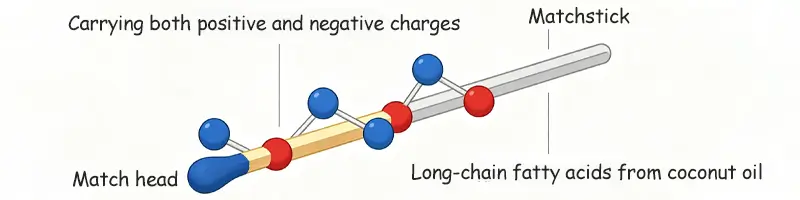
Cocamidopropyl betaine is not a natural product, but a highly processed, semi-synthetic chemical.
Its production process clearly reveals this. First, coconut oil is hydrolyzed to isolate saturated fatty acids such as lauric acid. Next, these fatty acids undergo a condensation reaction with a petrochemical derivative called “N,N-dimethylaminopropanamine” to form an intermediate. Finally, in the most critical step, this intermediate undergoes a quaternization reaction with sodium chloroacetate to ultimately form cocoyl amide propyl betaine.
Throughout the entire process, coconut oil provides only the fatty acid chains, which constitute a portion of the final molecular weight. The subsequently introduced amino groups, amide groups, and the acetate groups that introduce a charge have absolutely nothing to do with nature. It is a precise molecular assembly process, not a simple physical pressing or extraction.
Therefore, it can at most be called a “naturally derived compound.” Its safety and mildness do not stem from its “natural” origin; rather, it is precisely because humans have performed precise chemical modifications on the natural fatty acid chain in the laboratory that its irritating properties have been tamed and it has been endowed with the performance characteristics required for industrial applications.
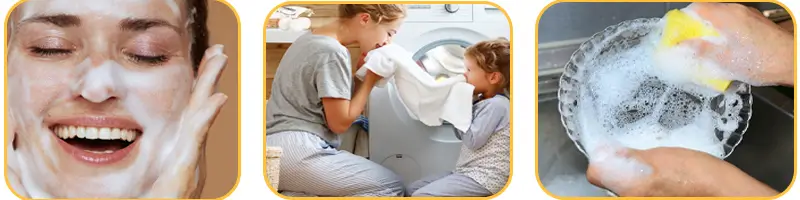
In shampoos, facial cleansers, body washes, and especially infant and toddler cleansing products, CAPB is key to reducing irritation and protecting the skin’s lipid barrier. When paired with SLES or amino acid surfactants, it significantly reduces the anionic charge density of the latter, transforming a tight, itchy cleansing sensation into a soft, moisturizing one. At the same time, it can carry cationic conditioning agents (such as polyquaternium salts), achieving a two-in-one effect of cleansing and smoothing.
What formulators value most about CAPB is its exceptional thickening ability. With just a small amount of salt (sodium chloride), it forms massive mixed micelles with anionic surfactants, instantly transforming a water-like liquid into a gel-like consistency. This characteristic shapes our intuitive perception of “concentrated” and “nourishing” textures. Furthermore, it produces long-lasting, dense foam, enhancing the pleasure of use.
Thanks to its resistance to hard water and high foaming properties, Cocamidopropyl Betaine is also used in high-end dishwashing detergents and multi-purpose hard-surface cleaners. Even in industrial applications—such as foaming oil displacement agents in oil fields, firefighting foams, metalworking fluids, and wool cleaning—it is highly favored for its stability and lubricity under both acidic and alkaline conditions.
Its cationic properties give it certain antistatic capabilities and mild antibacterial effects. It is occasionally found in fabric softeners and oral care products (at low concentrations), helping to achieve gentle results without harming mucous membranes.

Cocoyl amide propyl betaine (CAPB) itself has an excellent safety record. At current concentrations and under standard conditions of use, CAPB is safe as a cosmetic ingredient.
Its potential to cause sensitization stems almost entirely from residual synthetic byproducts. During the synthesis process, two allergens are produced as byproducts: 3,3-dimethylaminopropanamine (DMAPA) and amidoamine. If the raw material’s purification process is not sufficiently advanced, these trace impurities may remain in the finished cocamidopropyl betaine product and potentially trigger allergic symptoms—such as eczema on the scalp and face or eyelid dermatitis—in some individuals. This also explains why some people experience redness, itching, and discomfort after using hair and skincare products labeled as “natural and gentle.”
This discovery has spurred process upgrades across the industry. Today, responsible suppliers can use vacuum distillation or proprietary purification technologies to control DMAPA residues in high-purity CAPB to below 50 ppm (i.e., 0.005%) or even lower, ensuring that the refined product rarely causes allergic reactions in practical use.
If you experience stinging, redness, or itching after using a product containing cocamidopropyl betaine CAPB, be mindful of the following:
Choose reputable brands and supply chains: Major brands typically source high-purity CAPB ingredients, with strict controls in place to minimize impurities. This is the most effective way to avoid exposure to allergens such as DMAPA.
Look for labels such as “low-allergenic” and “sensitive skin tested”: These products typically require the use of higher-purity ingredients or employ formulation strategies to further reduce risks.
Conduct a simple patch test: Apply a small amount of the product behind your ear or on the inside of your wrist, and observe for 24–48 hours. If persistent redness, swelling, or itching occurs, discontinue use and consult a dermatologist.
Distinguish between “surfactant allergies” and “formulation allergies”: Cleansing products consist of multiple ingredients, and preservatives and fragrances are often more common allergens. Do not attribute all discomfort to CAPB.
Jinan Jinbon Chemical is a professional supplier of chemical raw materials. Our products offer stable and reliable performance, highly competitive prices, reliable bulk supply, and timely delivery, along with technical support for customized needs. If you are interested in purchasing cocoyl amide propyl betaine, please feel free to contact us.
We are always committed to delivering optimal chemical solutions for all application scenarios.